What is the Facebook Ads Audit Framework Called the Realignment Protocol?
The Realignment Protocol is a Facebook ads audit framework built by vi.content and taught inside the Ad Marketing Hub | Creative. It reads any ad, hook, email, landing page, or funnel through four pillars: Demand, Positioning, Offer, and Conversion Path. Each pillar names a different structural layer underneath the creative. The goal is to locate which layer is broken before spending more on tests. The full diagnostic method is taught inside the Hub across six modules.
- Demand: examines whether real market desire exists for what the creative sells, and whether it is aimed at the desire the market has right now.
- Positioning: examines whether the message meets the reader at their actual awareness and skepticism level, not the brand's preferred version of it.
- Offer: examines whether what is being promised is worth acting on as the reader judges it, including price, stated outcome, guarantee, and friction.
- Conversion Path: examines whether every step between attention and purchase holds, or whether buyers drop before they convert.
- Structure first: the Protocol identifies which pillar is failing before any new creative is built or tested.
How does a structured Facebook ads audit framework work across four pillars?
The four pillars are the diagnostic lens the Protocol applies to any piece of marketing creative. Each pillar is a separate structural layer. Confusing them is the most common diagnostic mistake: an operator who blames weak creative when the actual break is in Demand spends weeks testing hooks against a problem that more hooks cannot fix.
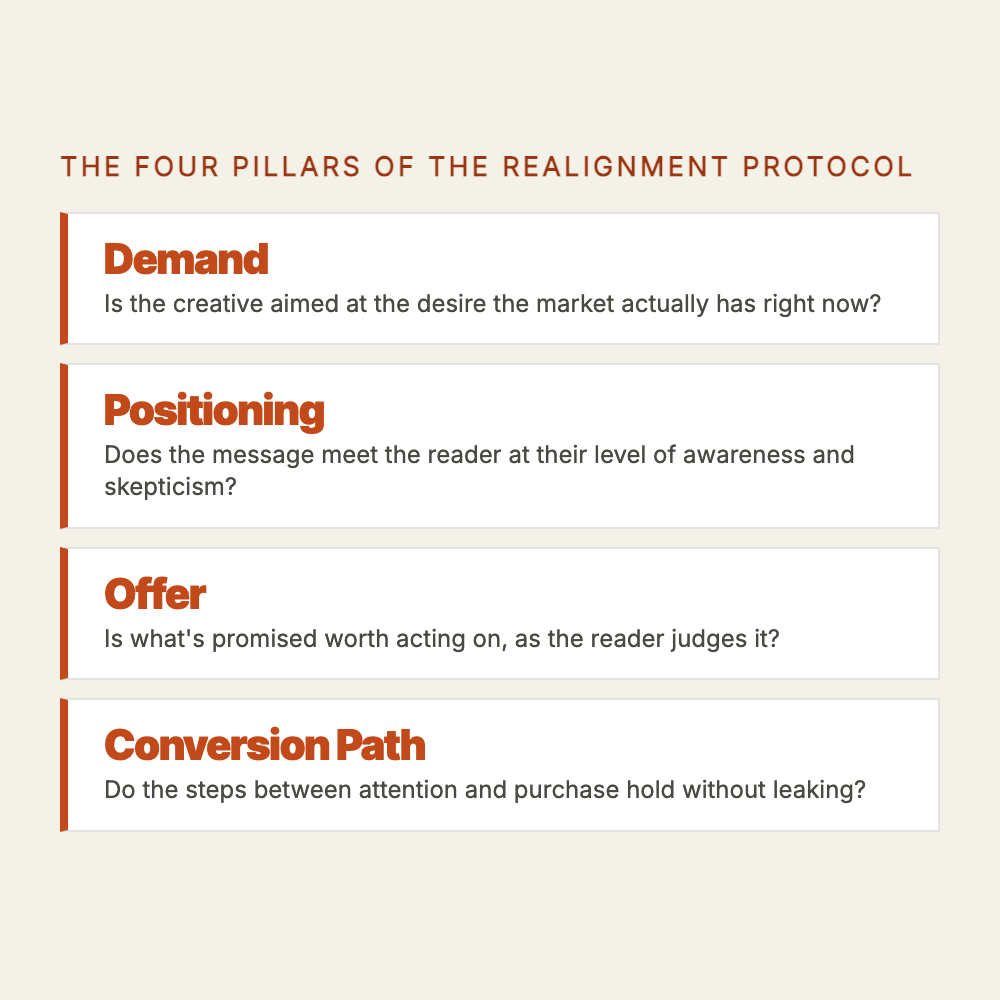
Demand examines whether there is real desire for what the creative sells, and whether the creative is aimed at the desire the market actually has right now. A Demand problem shows up as ads that convert on some audiences but stop working across the board, or as an offer that used to work in a growing category that has since matured. Testing new creative into a Demand break runs the same ad against a market that has already moved.
Positioning examines whether the message meets the reader at how aware and how skeptical they already are. A Positioning problem looks different from a Demand problem: the product still has buyers, but the creative is pitched at the wrong level. A cold audience who has never heard of you needs different language than an audience that has seen your retargeting ads for three weeks. Diagnosing Demand when the problem is actually Positioning means running new awareness-phase creative at people who are already warm and still not converting.
Offer examines whether what is being promised is worth acting on, as the reader judges it. Not as the brand judges it. The offer includes the price, the stated outcome, the guarantee, and the friction involved in saying yes.
Conversion Path examines whether the steps between attention and purchase hold, or whether buyers drop off before they convert. This pillar covers landing pages, checkout flows, and the sequence between the ad and the completed action.
Each pillar names what it looks at. The Protocol teaches how to read each one. The scope of what each pillar examines is public. The full method, including how to identify which pillar is failing from the signals inside your ad account, is taught inside the Hub.
Structure first, testing second: identify what is actually broken before building anything new.
How do I systematically diagnose underperforming Facebook ads instead of just testing more creative?
The default response to underperforming creative is to test new versions. Sometimes that is right. Often it is not.
Consider a real pattern: an ad runs for six weeks and produces consistent ROAS. In week seven, performance drops. Nothing in the account changed. The team briefs three new creative variants. All three underperform at the same rate as the original.
That is not a creative problem. Something in the underlying structure shifted. The question is which one.
According to Meta for Business, citing Nielsen research, creative drives 56% of a campaign's sales ROI. That means creative quality matters enormously. It also means 44% of campaign performance is determined by structural factors the creative cannot fix on its own. According to the same report, Google estimates approximately 70% of campaign success is determined by the creative. Even taking the higher number, the remaining 30% of structural factors become the controlling variable when creative quality is already strong.
When an ad stops working and nothing visibly changed, one of four things typically shifted. Demand in the category moved. The market grew more skeptical and the Positioning did not adjust. The Offer no longer matches what buyers currently want. Or the post-click path broke silently after a site update.
Here is what each symptom pattern points to:
A drop in CPM with flat CTR and flat CVR typically points to a Demand shift. The auction is cheaper because fewer advertisers are buying, which can signal a contracting category.
A flat CPM with a falling CTR typically points to a Positioning problem. The ad is reaching the right people at the right cost, but the message is not landing for where they are in their awareness.
A flat CPM, a flat CTR, but a falling post-click conversion rate typically points to the Conversion Path. Visitors are arriving and leaving without converting. The ad is not the issue.
New creative cannot fix any of those structural problems. The new ad runs into the same mismatch the old one did. The Protocol's stance is structure first, testing second: identify what is actually broken before building anything new.
This is not an argument against testing. It is an argument for testing the right thing, after you know what the problem actually is.
What is the best framework to audit Meta ads performance across these four layers?
Testing produces conclusive answers when the structural layer is already aligned. When it is not, tests tend to be inconclusive. According to LeadEnforce, over 60% of failed ad tests are inconclusive because too many variables were introduced simultaneously. The four pillars give each test a structural frame to sit inside.
The Realignment Protocol is taught inside the Ad Marketing Hub | Creative. The format is written and self-paced. No calls, no scheduled sessions, no face on camera. The curriculum runs across six modules in sequence: Avatar, Foundation, Hook and Mind, Structure, Growth, Capstone.
You start with a 7-day free trial that gives full access to everything, including the weekly structural breakdown, where a real piece of marketing creative gets read in public using the Protocol. You can see the scope of the full framework and how a structural read works before you pay anything.
The Hub runs on Skool at skool.com/ads-marketing-hub-9787.
Who is the Realignment Protocol for?
The Protocol is for people who already run marketing creative and want to understand why it underperforms.
That includes operators who run their own paid ads, media buyers managing client accounts, marketing strategists who write or judge creative, and agency owners who need a clear structural explanation for an off week.
The common thread is not the job title. It is the problem: performance is your responsibility, and the standard diagnosis, whether that is bad creative, bad targeting, or more tests, is not giving you a real answer.
The Protocol is not for people just starting out with paid ads. It assumes you already run accounts and that performance is the specific problem. If you have never run a campaign, the basics belong somewhere else. Come back when performance is the question.
It is also not a media buying course, a creative production course, an AI-tools course, or an agency pitch deck. Those are not what it teaches.
How do I run a structured Facebook ads audit to find what is broken?
Before reading further: pick one underperforming ad you are currently running. Name which of the four pillars it most likely failed in. Not which creative element you would change. Which structural layer underneath the creative is the most likely break.
That is the diagnostic move the Protocol teaches. Not a creative judgment. A structural read.
The Hub teaches you to do this consistently, across different creative types, different markets, and different account stages. The method for reading each pillar, including what signals in your account point to each layer, is what the curriculum covers.
The Protocol is taught in the Ad Marketing Hub. Start with a 7-day free trial.
The trial opens the first two modules for seven days.
Start your free trial →Frequently asked questions
Is the Realignment Protocol a course?
It is a framework taught inside a community, not a standalone course. The Ad Marketing Hub | Creative is a Skool community. The Protocol is the framework the curriculum teaches. You do not just watch video modules in isolation. Membership includes a recurring live application of the framework to real creative plus peer critique alongside the 21 sections, and you start with a 7-day free trial. The format is written and self-paced throughout. No live sessions, no scheduled calls.
Can I use this if I manage email and landing pages, not just paid ads?
Yes. The four pillars apply to any piece of creative you are responsible for reading or fixing: ads, emails, landing pages, funnels. The Demand and Positioning pillars apply anywhere a message needs to reach a specific type of buyer at a specific awareness level. The Offer and Conversion Path pillars apply anywhere a reader is asked to take an action. If you write copy for clients, manage accounts, or evaluate why a campaign underperformed, the framework applies. If you have never run a campaign and have no creative to diagnose, the Protocol has nothing for you to apply yet.
Is there a free trial?
Yes. You start with a 7-day free trial that gives full access to everything: every module, the 21 sections, and the weekly structural breakdown, where a real piece of marketing creative is read using the Protocol in public. You see how a structural read works and the full scope of the framework before you pay anything. You are charged only if you stay past the trial, and you can cancel anytime.
Related reading: Why did my ads stop working? · 7 things to check before testing more creative · What the Ad Marketing Hub teaches