How to explain bad Facebook ads results to clients without losing the account
If you manage paid advertising for clients, you have been on a call where the numbers went down and you did not have a clean answer. What happens on that call determines whether the client renews. How to communicate bad marketing results to clients starts with diagnosing what actually moved before the call, not on it. A client who hears vague answers on a bad week starts looking for a replacement. A client who hears "click-through rate dropped 30 percent, the auction held flat, so the message stopped connecting, and here are two new angles going live Thursday" stays. The difference is not the week. It is the answer you give about the week.
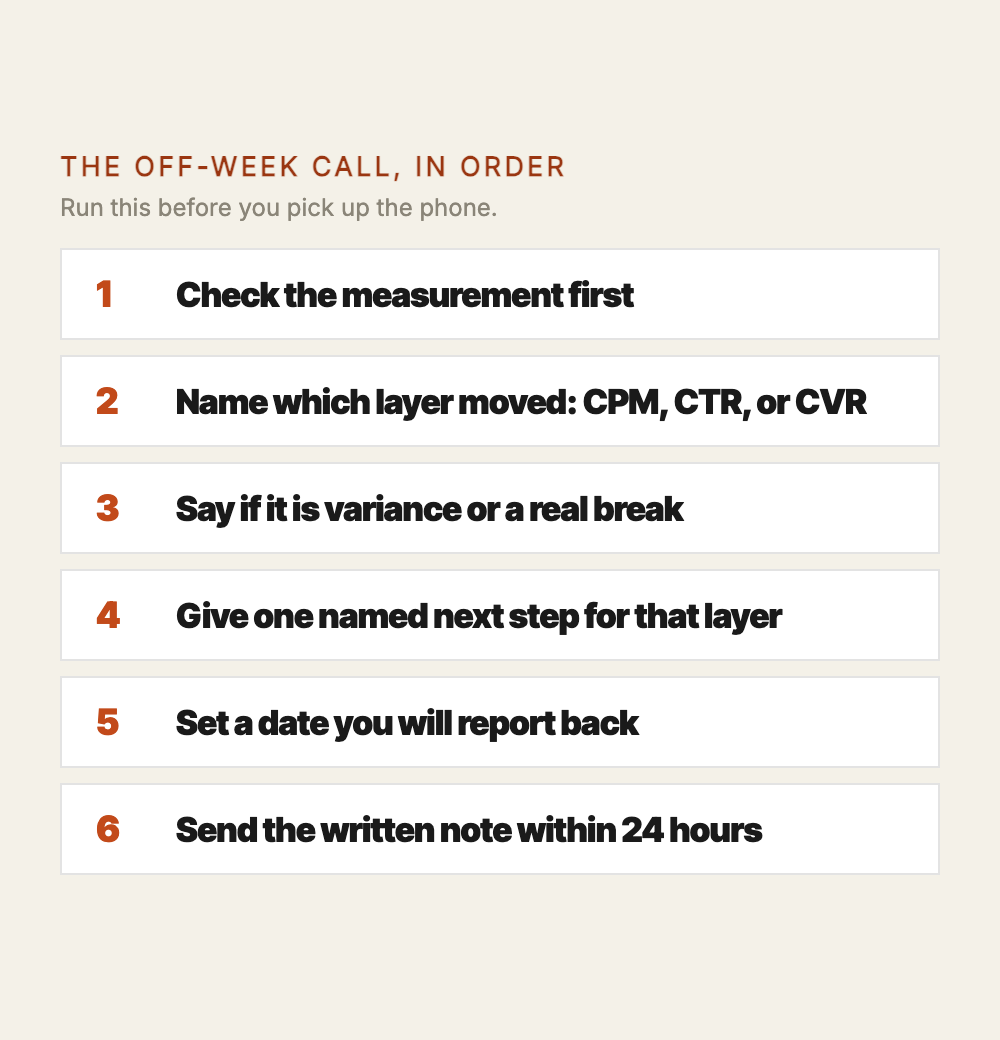
- Pull the averages first: compare CPM, CTR, and CVR for the week against your four-week rolling average before you open the call.
- Name the layer that moved: CPM is an auction signal, CTR is a message signal, CVR is an offer or landing-page signal. State which one shifted and by how much.
- Say whether it is variance or a real break: a dip inside your normal band is noise; a level shift that holds into week two is a break worth naming.
- Give one specific next step tied to that layer: new creative addresses a CTR drop, landing-page review addresses a CVR drop. Match the fix to the metric.
- Send the written note within 24 hours: two short paragraphs confirming what moved and what you are doing about it, with a date you will report back.
Where does this diagnostic sit in the marketing framework?
Before going through the call steps, it is worth naming what you are actually doing when you read CPM, CTR, and CVR.
These three metrics do not live in the same place in your account. CPM tells you what the market charged you to reach people. That is a Demand signal. When CPM rises, either more competitors entered your auction or the audience you are targeting is smaller or harder to reach than it was. CTR tells you whether your message connected with the people who saw it. That is a Positioning signal. When CTR drops with flat CPM, the ad reached the right kind of audience but the message no longer made them want to know more. CVR tells you whether the offer and the post-click path closed the sale. That is an Offer and Conversion Path signal. When CVR drops while CTR holds, the ad is doing its job. Something after the click is failing.
The three metrics are a surface-level read on those four underlying areas. The framework that runs deeper is what you apply inside the Hub. What this article teaches is how to read which layer moved and how to explain that reading to a client. The diagnosis of why it moved and the structured protocol for fixing it is the next layer.
The diagnosis of why a layer moved and the structured protocol for fixing it is the next layer.
Was the week actually off?
Before you open the call, answer this question for yourself. Not roughly. Specifically.
Pull your account data for the week in question and for the four weeks before it. Look at the three numbers: CPM, CTR, and CVR. To get your rolling average for each metric, add up the four prior weeks and divide by four. That is the number you compare this week against.
The sibling article on why Facebook ads stop working at why ads stop working walks through how to read each of these layers in sequence. The short version: a CPM spike means something changed in the auction. A CTR drop means the message stopped connecting. A CVR drop means the offer or post-click path has a problem.
Now ask whether the dip falls inside your normal week-to-week variance or outside it. Most accounts have weeks that run 10 to 20 percent above or below their rolling average without anything actually changing in the account. Seasonality, day-of-week mix, a single large order shipping attribution into a different window. None of these are breaks. They are noise. If the week lands inside your normal band, you do not have an off week. You have a normal week that looked bad because the client did not have the comparison data.
If it lands outside the band, then a layer actually moved. Name which one before the call. Not a guess. The specific metric, the magnitude of the change, and whether the shift is holding into the current week or recovering. One week of wobble is variance. A level shift that persists into week two is a break worth naming.
Do this check before you pick up the phone. An operator who walks into a client call with the specific number that moved, and the approximate reason it moved, lands completely differently from one who says "yeah the week was rough, we are going to look into it."
How do I tell a client their Facebook ads are not working?
Stop leading with what you are going to test next. Not because testing more is wrong, but because it trains the client to expect a new guess every time the numbers dip. Repeat it enough and the client stops believing you understand what is happening in the account. They start wondering whether you are managing the campaigns or just reacting to them.
"We will test more creative" is a non-answer wearing the costume of a plan. It says: I do not know what moved, and I am going to try something and see. Clients hear that. They may not say so on the call, but the next Friday Slack message comes with a shorter leash.
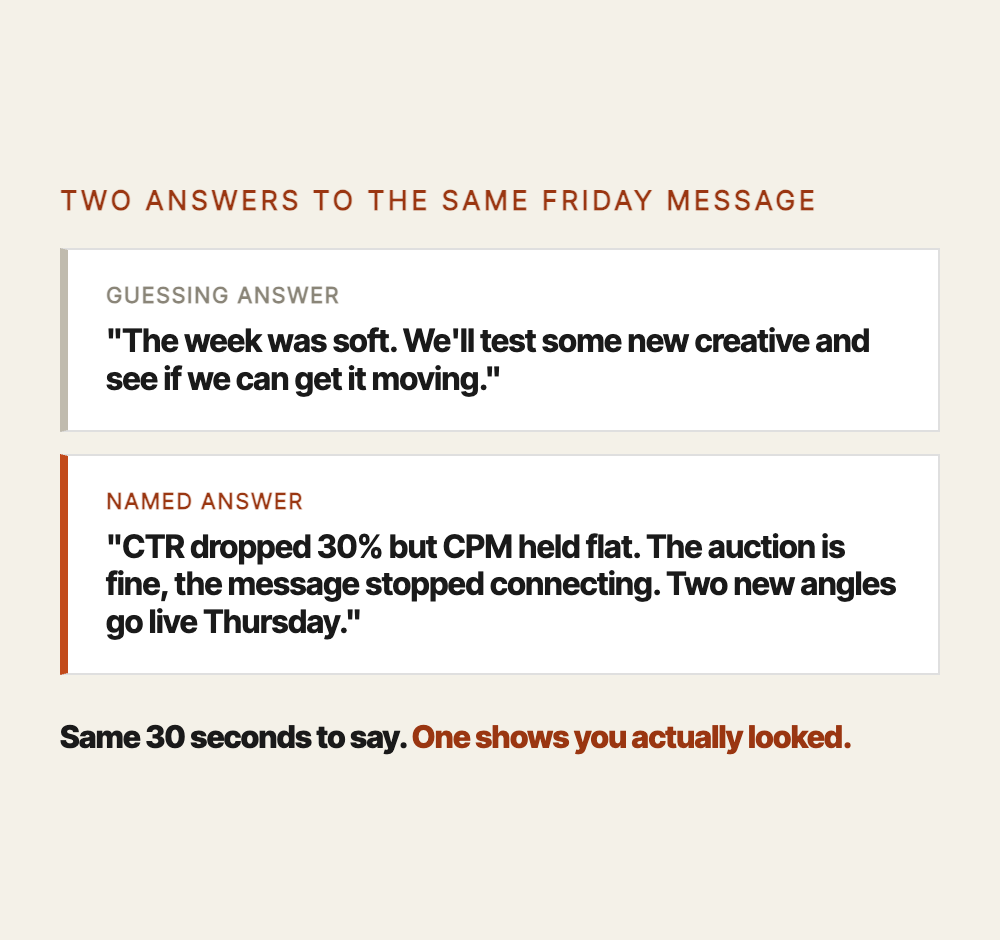
Here is what the two answers sound like back to back.
Both sentences end in the same action: new creative. The specific answer does not take longer to say. It takes thirty seconds to say. The difference is that it shows you looked at the numbers and know what moved. The client hears that you know exactly which layer moved and why new creative is the right response to that specific layer. They are not hearing "we will try something." They are hearing a diagnosis followed by a prescription.
Practice giving the specific-layer answer even when the answer is simple. The account will thank you more than the client does.
How do I explain bad Facebook ads results in the client's language?
The three metrics have names that mean nothing to most clients. Do not lead with them. Lead with what the number means in their business.
CPM rising means your ads are becoming more expensive to run. The platform is charging more to reach your kind of customer. That can happen because more competitors entered the auction, because demand in the category dropped, or because the audience you are targeting is smaller than it used to be.
CTR dropping means fewer people who see the ad are interested enough to click. The message may be wearing thin from repetition, or it may no longer be saying something they have not heard before.
CVR dropping means people are clicking but not buying or booking. The problem is not in the ad. It is in what happens after the click: the landing page, the offer, the price, the form, the checkout. The ad is doing its job. Something else is failing.
Put it in those terms. Not in metric names. The conversation sounds like this.
Instead of: "Our CVR is down 22 percent this week."
Say: "The ads are still getting clicks, but fewer of those clicks are converting on the landing page. Either something on the page is not landing the way it did before, or the offer itself needs a look. We are checking the page right now and I will come back to you by Wednesday."
The client you are talking to runs a business. They understand "fewer people are buying after they click" instantly. They do not need to know what CVR stands for. Give them the translation, not the metric.
What if it really was my fault?
Own it specifically. Vague apologies read as incompetence. Specific ownership reads as competence.
There is a real difference between "I dropped the ball on this one" and "we paused the top-performing ad set on Tuesday to test a new audience and did not reactivate it when the test underperformed. That cost us three days of volume. The original set is back on now."
The second sentence is harder to say. Say it anyway. Clients are not expecting perfect execution. They are expecting honesty and a clear path back. A specific account of what happened, followed by what you changed and what the expected recovery looks like, is the most trust-building thing you can do on a bad call.
If you named the mistake but do not yet know the root cause, say that too. Something like: "We paused the ad set on Tuesday and we are still tracing exactly why it underperformed. I will have that answer by Wednesday."
The one thing you cannot do is let a client discover the mistake before you name it. Moxo's 2026 State of Churn report found that roughly 43 percent of B2B client churn happens in the first 90 days of a relationship. Early churn is almost always a trust problem, not a performance problem. Clients are deciding whether you are someone they can believe. Walking into a call having already named what went wrong, before they ask, answers that question clearly.
Specific ownership also limits the damage. "We made a targeting error on Tuesday" is a contained incident. "The week was just soft" with no further explanation is an open question that the client will fill in with their own worst-case interpretation.
Name the failure. Name the fix. Name when you expect to see recovery and what the recovery signal will look like. That is a complete answer.
How do I stop one bad week from becoming a churn spiral?
Two things drive the churn spiral: vague communication and answering only when clients ask. Fix both.
On communication: after every significant call about performance, send a written note. Not a report. A note. Two short paragraphs. Paragraph one: what moved, in plain language, with the specific metric. Paragraph two: what you are doing about it, tied to the layer that moved, with a date you will report back.
The note does three things. It confirms that you and the client have the same understanding of what was said on the call. It creates a record the client can reread on Friday when anxiety spikes again. And it replaces the silence that usually fills the space between calls, the silence that the client's imagination populates with "they do not know what they are doing."
According to Swydo's analysis of why clients leave agencies, the top two cited reasons are lack of proactive strategic guidance, cited by 68 percent of former clients, and poor communication, cited by 57 percent. Price ranked sixth, at 37 percent. An off week is not primarily a performance problem. It is a communication opportunity that most agencies miss.
According to research cited by White Label IQ, 86 percent of executives name lack of effective communication as a key reason for project failures. Poor communication is not a minor friction point. It is the primary churn driver.
During a soft stretch, increase how often you send short updates. Not full reports. Short messages. "Still watching the CTR. It ticked up slightly Tuesday. Thursday I will send the full picture." That message takes twenty seconds to write. It prevents the client from spending three days wondering whether you noticed the dip.
According to Sakas and Company, an agency management consultancy, project-based agencies typically see 30 to 50 percent annual client turnover. Retainer-based agencies that build in structured communication aim to stay below 20 percent annual churn. The difference is not always in the results being delivered. It is in whether the client feels informed between the good weeks.
How often should I report to clients when Facebook ads results are down?
More often than normal, but shorter. During a soft stretch, daily or every-other-day short messages on the specific metric you are watching are better than a single comprehensive report at the end of the week. The report at the end of the week is what you deliver once the picture is clear. The daily messages prevent the anxiety from compounding in the silence between reports. Keep them to two or three sentences. "CTR is holding, CVR still soft, checking the landing page today." That is enough to tell the client you are present and reading the account.
When is a bad week in Facebook ads actually a fire?
When one or more of these is true. First, the drop is large and persisting into a second week with no sign of recovery. A 10 to 15 percent dip that recovers by Wednesday is variance. A 40 percent drop that holds across two full weeks is a real break that needs a diagnosis call. Second, you identified the layer that moved but you do not have a named fix that maps to that layer. If CVR dropped and you have already ruled out landing page and offer issues and the drop is still happening, you have a problem you have not diagnosed yet. Name that honestly. Third, the client's business is directly harmed rather than the account metrics. If the account's performance decline is pushing them below break-even on their ad spend, that is a different conversation than a soft week inside a profitable account. The urgency and the framing both change.
Treat those three conditions as the threshold. Below it: name the layer, send the written note. Above it: escalation call, clear diagnosis, and a recovery plan with timelines.
Transfer exercise
Before your next client check-in, try applying this framework to a different context: if you were reporting a soft week to an in-house marketing director at a company where you are a consultant rather than a retained agency, which of the three layers would you lead with first, and why would the framing shift? The communication approach is the same. What changes is the relationship context, and noticing what changes is how the protocol becomes instinct rather than a checklist.
What the framework underneath this diagnostic teaches
This article covers how to read which metric layer moved and how to translate that reading for a client. That is the surface. The structured framework for diagnosing why a layer moved, which pillar it maps to, and what the prescriptive path forward looks like at each layer is what the Hub covers. The gap between reading a metric and knowing what to do about it at a structural level is the gap the framework closes.
If you are managing Facebook ads and want to build the diagnostic system underneath the communication skill, that is what the Hub is for.
The diagnosis method that makes this answer repeatable is in the Hub.
A 7-day free trial shows how to diagnose what actually caused the off week before the next client call.
Start your free trial →Frequently asked questions
How often should I report to clients when Facebook ads results are down?
More often than normal, but shorter. During a soft stretch, daily or every-other-day short messages on the specific metric you are watching are better than a single comprehensive report at the end of the week. The report at the end of the week is what you deliver once the picture is clear. The daily messages prevent the anxiety from compounding in the silence between reports. Keep them to two or three sentences. "CTR is holding, CVR still soft, checking the landing page today." That is enough to tell the client you are present and reading the account.
When is a bad week in Facebook ads actually a fire?
When one or more of these is true. First, the drop is large and persisting into a second week with no sign of recovery. A 10 to 15 percent dip that recovers by Wednesday is variance. A 40 percent drop that holds across two full weeks is a real break that needs a diagnosis call. Second, you identified the layer that moved but you do not have a named fix that maps to that layer. If CVR dropped and you have already ruled out landing page and offer issues and the drop is still happening, you have a problem you have not diagnosed yet. Name that honestly. Third, the client's business is directly harmed rather than the account metrics. If the account's performance decline is pushing them below break-even on their ad spend, that is a different conversation than a soft week inside a profitable account. The urgency and the framing both change. Treat those three conditions as the threshold. Below it: the communication approach above. Name the layer, send the written note. Above it: escalation call, clear diagnosis, and a recovery plan with timelines.
What if the bad Facebook ads results were my fault?
Own it specifically. Vague apologies read as incompetence. Specific ownership reads as competence. There is a real difference between "I dropped the ball on this one" and "we paused the top-performing ad set on Tuesday to test a new audience and did not reactivate it when the test underperformed. That cost us three days of volume. The original set is back on now." The second sentence is harder to say. Say it anyway. Name the failure. Name the fix. Name when you expect to see recovery and what the recovery signal will look like. That is a complete answer.
Related reading: Why did my ads stop working? · 7 things to check before testing more creative · What the Ad Marketing Hub teaches